Across Texas, students deserve college and career pathways that prepare them for success long before graduation.
At Tomball Star Academy, collaboration is creating new opportunities for students. School systems, higher education, and healthcare partners are working together so students graduate with both college credit and a clearer path toward a career.
To experience that work firsthand, Educate Texas recently welcomed more than 60 education, workforce, philanthropy and policy leaders to Tomball Star Academy. The visit highlighted how the campus’s Healthcare Pathways in Technology Early College High School (P-TECH) and Early College High School (ECHS) programs connect classroom learning with dual credit coursework, industry-recognized credentials, career-connected learning and real-world healthcare experiences. It also demonstrated how recent state investments are helping expand high-quality college and career pathways for students across Texas.
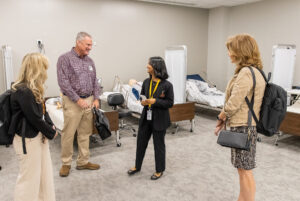 Inside the classrooms and hallways, the impact was unmistakable.
“Tomball Star Academy has prepared me for college through its amazing partnership with Lone Star College and its partnership with HCA.”
— Tomball Star Academy Student
For another student, the Healthcare P-TECH program has transformed a career aspiration into a clear plan.
“Being here at Tomball Star is really going to push me forward in my career to become a veterinarian in the future. So that way, when I do go to college, I’m already ready to start jumping into my coursework, and also those two free years of college will save me a lot of money in the long term.”
— Tomball Star Academy Student
Their experiences reflected a common theme throughout the visit. Students described balancing college-level coursework with high school expectations, learning to advocate for themselves, developing leadership skills and gaining experiences that helped them better understand where they wanted to go after graduation. They spoke as confidently about who they were becoming as they did about the credentials they were earning.
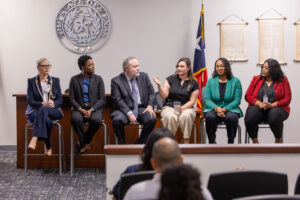 Families described that same transformation from another perspective.
Parents shared stories of watching uncertainty give way to purpose as their children discovered interests, developed professional skills and began pursuing careers they had never imagined possible. One parent reflected on seeing an early interest in healthcare become a tangible pathway through clinical experiences, college coursework and mentorship from professionals in the field. Another described the difference it made to have educators who recognized her daughter’s potential and encouraged her to keep growing.
Those stories are the result of intentional collaboration.
Dr. Victoria Brinkman, principal of Tomball Star Academy, explained:
“Without partnerships, none of this is possible. Every single one of those partners works in order to make sure that this program can function and can exist. It’s an early college high school, so you’ve got to have that partner with the IHE. Our IHE is Lone Star College Tomball. On our P-TECH side, having our business industry partner with HCA Healthcare Tomball and how incredible they have been in giving our students opportunities. That partnership really helps to build those experiences.”
— Dr. Victoria Brinkman, Principal, Tomball Star Academy
That collaborative approach extends well beyond a single campus. Through Healthcare P-TECH and Early College High School, Tomball ISD, Lone Star College-Tomball, HCA Houston Healthcare Tomball and regional partners have created a model that allows learners to earn dual credit, complete workforce-aligned coursework, explore healthcare careers and build valuable skills before graduating from high school. The program reflects how career and technical education (CTE), higher education and industry partnerships can work together to strengthen the talent pipeline for Texas communities.
Educate Texas works alongside communities across the state to strengthen these kinds of cross-sector partnerships by convening education, workforce, philanthropy and policy leaders, advancing evidence-informed policy and helping communities implement high-quality college and career pathways that respond to regional workforce needs.
The visit also demonstrated how recent legislative investments, including House Bill 2 and House Bill 120 from the 89th Texas Legislature, are supporting the continued growth of programs like Healthcare P-TECH and Early College High School. Rather than discussing policy in the abstract, attendees saw how those investments translate into expanded opportunities for students, stronger regional workforce pipelines and communities better prepared to meet the demands of Texas’ growing economy.
Tomball Star Academy is one example of what can happen when K-12 education, higher education, employers, philanthropy and public policy are aligned around a shared commitment to students.
The impact is measured in more than college credits, certifications or workforce outcomes. It is reflected in young people who leave high school with direction, families who see new possibilities for their children and communities that are investing together in the next generation.